
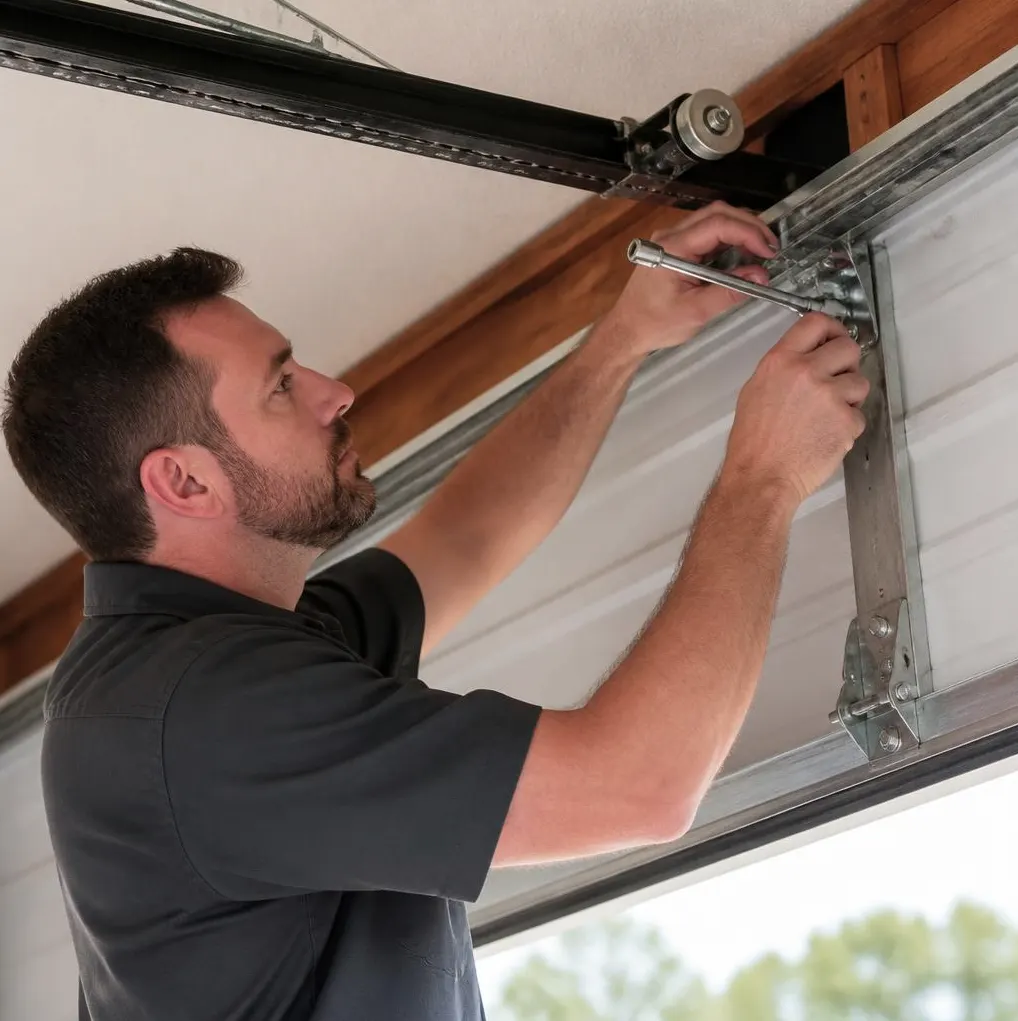
Rule of thumb: nine times out of ten, a garage door that won't open is either a dead safety sensor or a broken spring, not a failed opener. The exceptions are real, though — a tripped breaker after a storm, a stripped plastic gear inside an older opener, or a track that iced over during a cold snap can all stop a door cold. The trick is checking things in the right order so you don't replace a part that was never the problem.
What You're Actually Seeing
Before any fix, it helps to know which symptom you've got, because each one points a technician toward a different starting place:
- Nothing happens at all — no light, no hum, no click — when you press the remote or wall button.
- The opener hums or clicks but the door doesn't move, or it moves an inch and stops.
- The door opens partway and reverses back down, or won't close all the way.
- The door is heavy, uneven, or won't budge even by hand with the opener disconnected.
The Order a Technician Checks Things
1. Power to the opener
First stop is always the obvious one: is the opener actually getting power? A tripped breaker, a half-pulled plug, or a GFCI outlet that popped after a storm will stop a door just as fast as a mechanical failure. This matters more here than it does in milder climates — spring storm season brings power surges, and a breaker that trips during a thunderstorm sometimes doesn't get noticed until someone tries the garage door days later.
2. Remote batteries and safety sensors
If there's power but the door won't respond, the next check is the remote (dead batteries are the single most common cause of "it worked yesterday") and then the two small safety sensors near the bottom of the tracks. If their lenses are dirty, knocked out of alignment, or one has a blinking light, the opener will refuse to close the door as a safety feature — and on some units it will refuse to open it too. Road salt spray and winter grime are a real factor here; sensors mounted low near the driveway collect film from salted roads all winter and need a simple wipe-down.
3. Manual lock or vacation mode
Many openers have a lock button on the wall console, and some keypads have a vacation or lockout mode. If someone bumped the button or a keypad lost its programming, the opener will act dead even though nothing is actually broken. This takes thirty seconds to rule out and is easy to overlook under stress.
4. Disconnected trolley (the emergency release)
Every opener has a red-handled rope that disconnects the door from the chain or belt — it's meant for power outages. If it got pulled accidentally, or pulled during an outage and never reset, the opener will run but the door won't move with it. Reconnecting it is simple: pull the release toward the opener until it clicks back into the carriage, then test with the opener.
5. Broken or weakened spring
If the door won't move even by hand with the opener disconnected, or it's noticeably heavy on one side, a spring has likely failed. A loud bang at some point (even days earlier) is a classic sign. Cold temperatures are hard on springs — metal contracts in the cold, and the first real cold snap of the season is a common time for an aging spring to finally let go. This is not a DIY repair. Torsion springs are wound under enough tension to cause serious injury, and the fix involves releasing that tension safely, installing a correctly sized replacement spring, and rebalancing the door.
6. Cables and tracks
Next, a technician looks at the lift cables and the tracks themselves. A cable can jump its drum or fray, and tracks can bend from an impact or get packed with ice and debris in winter. A door that binds, jerks, or opens crooked usually traces back here. Fixing it ranges from re-seating a cable to replacing a bent track section.
7. Opener gear or sprocket
If the motor runs (you hear it) but the chain or belt doesn't move the door, the internal drive gear — often made of plastic — has likely stripped. This is common on older openers that have been in service for many years and is a straightforward internal repair or, if the unit is old enough, a good trigger to consider a new opener.
8. Limit switch and force settings
Finally, if the door opens or closes partway and reverses, the limit or force settings inside the opener may be off, sometimes from age, sometimes from a battery backup unit resetting itself. Reprogramming these settings restores normal travel distance and reversing behavior.
When to Call Aberdeen Garage Door
If you've ruled out dead batteries, a locked switch, and a tripped breaker and the door still won't open, it's time to call rather than keep guessing — especially if a spring is suspected. Our Spring Replacement service includes a full safety check of cables and tracks at the same time, since a failed spring often stresses those parts too. If the opener itself is the problem — stripped gear, bad logic board, or settings that won't hold — our Garage Door Opener Repair & Installation service covers both a repair and, when it makes more sense, swapping in a new unit built for the temperature swings this area sees.
If your door in Aberdeen, Ripley, Georgetown, Maysville, Manchester, Russellville, West Union, or Hillsboro has stopped opening, call Aberdeen Garage Door today — we'll find the actual cause, not just the easiest guess, and get it fixed before the next cold snap settles in.